
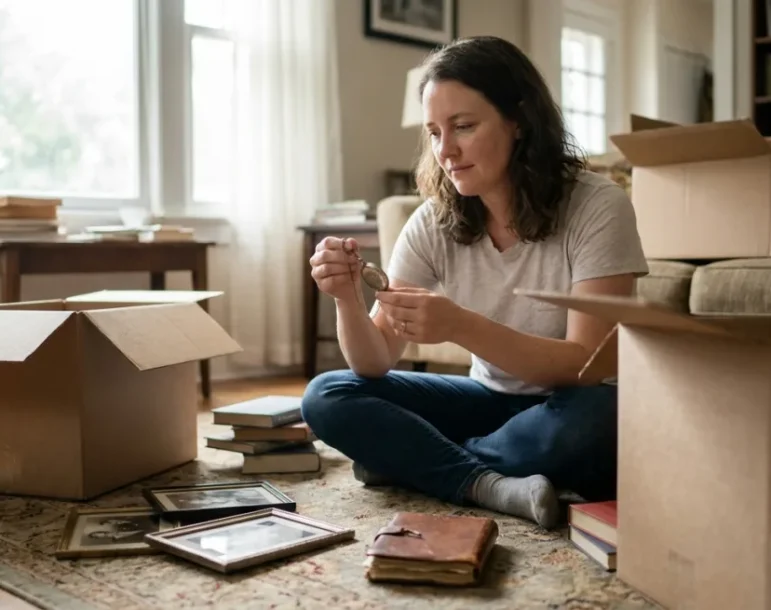
When a loved one dies without a will in California, state law — not family preference — decides who has the legal right to their personal belongings. Here’s what the law actually requires, and how to move forward.
Dealing with personal belongings after death without a will is one of the most disorienting tasks a grieving family faces. You may be standing in a parent’s apartment, surrounded by furniture, jewelry, and keepsakes, with no document telling you who gets what, and other relatives asking questions you can’t answer.
California has a specific legal framework for exactly this situation. It’s called intestate succession, and it applies automatically when someone dies without a valid will or trust. Understanding how it works — and which shortcuts are legally available to you — can help you move through this process without making costly mistakes.
Personal Property and Real Property Are Both Subject to Probate Law
Before anything else, it helps to understand what the law means by “personal property.” In California, personal property includes tangible movable items: vehicles, furniture, clothing, jewelry, artwork, bank accounts, and household goods. Real property refers to land and the structures attached to it.
The distinction matters because families often assume physical belongings can be divided informally among themselves. Without legal authority, that can be risky. Personal property is still governed by California’s probate rules when someone dies intestate (without a will). A surviving family member cannot simply walk into a home, distribute heirlooms, and consider the matter closed. Doing so without legal authority could expose you to liability from other heirs or creditors of the estate.
California Intestate Succession: Who Inherits Personal Belongings
Under Cal. Prob. Code § 6400, any portion of a deceased person’s estate not covered by a valid will passes to the decedent’s heirs according to California’s intestate succession rules. Those rules depend heavily on one factor that sets California apart from most states: community property.
California is a community property state. That means property acquired during a marriage is generally owned equally by both spouses. When someone dies without a will, how their personal belongings are distributed depends on whether those belongings are community property or separate property.
When a Spouse Dies Without a Will
If your spouse dies without a will, California law typically gives you the full community property share outright. Separate property, which includes assets your spouse owned before the marriage or received as gifts or inheritance during it, follows a different path. Separate property is divided among the surviving spouse, children, parents, or siblings depending on which relatives survive.
The spouse gets all community property. For separate property, the split depends on who else survives. One child means an equal split between the spouse and child. Two or more children, and the spouse receives one-third of the separate property while the children divide the remaining two-thirds.
When a Parent Dies Without a Will
If no spouse survives, California distributes the estate to children in equal shares. If one child has predeceased the parent but left their own children (your nieces and nephews), those grandchildren step into their parent’s share through a rule called representation.
Parents, siblings, and more distant relatives inherit only when no closer relatives survive.
The California Small Estate Affidavit Avoids Formal Probate for Smaller Estates
Formal probate in California can take a year or more and involves filing with the superior court in the county where the deceased lived. For many families dealing with a no-will estate, that process feels overwhelming, especially when the assets at issue are household goods or a used car rather than real estate.
California provides a meaningful shortcut for qualifying estates. The California Small Estate Affidavit allows heirs to claim personal property directly from banks, vehicle title agencies, or other holders without going through formal court probate. The estate’s gross value must not exceed the statutory threshold, which is $208,850 for a person who died on or after April 1, 2025. The Judicial Council adjusts this figure every three years, so confirm the current amount with an attorney before filing.
This affidavit can be used no sooner than 40 days after the death. The person signing it declares, under penalty of perjury, that they are a lawful heir under California law and that the estate qualifies for the simplified procedure. Banks and other holders of the decedent’s property generally accept a properly completed affidavit.
One important caution: the affidavit covers personal property, not real estate. A home or other real property requires a separate court petition even for smaller estates.
Who Has Legal Authority to Manage and Distribute the Estate
Until probate is opened or an affidavit is presented, no single family member automatically has the legal authority to distribute a deceased person’s belongings. This surprises many families.
If formal probate is required, the court appoints an Administrator to manage the estate. Under Cal. Prob. Code § 8461, California sets a clear priority order for who the court appoints:
The Priority Order for Administrator Appointment
Surviving spouse or registered domestic partner is first in line. If none survives, the court moves to children, then grandchildren, then parents, then siblings, and so on down the family tree.
Once appointed, that Administrator is a “personal representative” under Cal. Probate Code § 58 and holds legal authority over the estate’s assets. They can access the deceased’s home, manage bank accounts, pay debts, and ultimately distribute personal belongings according to the intestate succession rules.
No Administrator appointment means no single person has the legal right to take property. A relative who removes items from the home before probate is opened may face claims from other heirs.
How to Physically Secure and Inventory a Deceased Person’s Belongings
The period immediately after a death is when mistakes happen. Relatives arrive, emotions run high, and items disappear before anyone has legal authority to distribute them.
Before anything is moved or claimed, the estate’s belongings should be inventoried. Document every room with photographs or video. List major items, their approximate value, and their location. This protects every heir and provides the Administrator with a record if disputes arise later.
If the deceased lived in a rental property, California law governs how the landlord handles remaining belongings. You do not have the right to break into a rented unit, even as a family member. Contact the landlord directly, explain the situation, and coordinate access. If the estate is in probate, the court-appointed Administrator can legally authorize entry. Without that authority, accessing a rental unit over the landlord’s objection could constitute trespass.
For bank accounts, financial institutions will ask for legal documentation before releasing funds. A death certificate is a starting point, but banks generally require either letters of administration from the probate court or a completed Small Estate Affidavit before releasing account balances to an heir.
Family tensions over sentimental items, photographs, heirlooms, and keepsakes, are common in no-will estates. Items with high emotional value and low financial value rarely have a legal resolution that satisfies everyone. A structured family conversation, sometimes facilitated by a neutral mediator, often works better than court intervention for these disputes. If the family cannot reach agreement, the dispute may need to be resolved through the probate court.
If Probate Is Required, It Runs Through Butte County Superior Court
For families in Chico and the surrounding Butte County area, formal probate proceedings are filed with the Butte County Superior Court. The court handles the petition for administrator appointment, creditor notice requirements, and ultimately the order distributing estate assets.
California probate follows a defined sequence, and the timeline from filing to distribution typically spans nine months to more than a year depending on the estate’s complexity and any disputes that arise. Having an attorney familiar with Butte County’s local procedures can reduce delays caused by filing errors or incomplete petitions.
Steps to Take Now If Your Loved One Died Without a Will
The situation is manageable. A clear sequence helps.
- First: Obtain multiple certified copies of the death certificate. You will need them for banks, title agencies, and court filings.
- Second: Determine whether the estate qualifies for the Small Estate Affidavit procedure. If the gross value of the estate is $208,850 or less (for a death on or after April 1, 2025), formal probate may not be required.
- Third: Inventory the physical belongings. Photograph everything before anything is moved.
- Fourth: If formal probate is required, petition the Butte County Superior Court to be appointed Administrator of the estate. Priority follows the order set by California Probate Code § 8461.
- Fifth: Consult a California probate attorney before taking any action you are unsure about, particularly involving bank accounts, rental properties, or disputes among family members.
- Talk to a California Probate Attorney About Your Situation
Every no-will estate is different. The mix of community and separate property, the number of surviving relatives, and the value of personal property all affect which legal path applies. An attorney familiar with California intestate succession and Butte County probate procedures can review your specific situation, identify whether the Small Estate Affidavit applies, and help you avoid the personal liability that comes from distributing assets without legal authority.
The information on this page is for educational purposes only and does not constitute formal legal advice. Laws and statutory thresholds, including the Small Estate Affidavit limit, are subject to change.